Friday, 15 June 2012

Serbia 28 Hungary 29 Poland 30 Central Africa 31

I think this is the "straightest" line from north to south that our meridian has ever accomplished. We begin today with the small nation of Serbia (28 on the map) then we move up to Hungary (29 on the map) then Poland (30 on the map) and finally we drop south to the Central African Republic that had a small stint in the  70's as a European style Empire. 


Serbia/Belgrade/Historical Museum (Periodic Display of 1crown)

Crown of Serbia 1901

With this piece, symbolism plays the main role. The crown was made in 1901 from bronze taken from a cannon used 100 years earlier in the Great Uprising. King Peter I was crowned on the anniversary to strengthen Serbian independence. Consisting mostly of enameled and gold plated bronze and set with a few stones, this crown has little intrinsic value but rather historic value. 

Hungary/Budapest/Parlaiment Buildings (Permanent Display 1crown)

Crown of St.Stephen

The Crown of St Stephen is considered to be one of the most holy of all the relic crowns of Europe. It is to this day believed in Hungary, and that if the crown was to either be destroyed or leave Hungarian soil, the country and its people would suffer total destruction. Also, no-one could claim sovereignty in Hungary without having total custody of the crown. For this reason the crown was vehemently pursued by Hitler during WW2 but it was so well hidden, that for years after the war its whereabouts were actually lost. This was considered to be the reason for the suffering, communism caused in those times. Controversy followed as reports of its whereabouts where eventually confirmed to be Fort Knox USA. It was eventually recovered and restored to the people of Hungary, where it is on display for them in the Parliament Building in Budapest, today. Ironically, or should we say, as providence would have it, the fall of communism and eventual economic growth has also returned to the beleaguered people of this ancient country.

Hungary/Budapest/National Museum (Permanent Display 3crowns)

Votive Crown of Nagyvarad


Crown of St Margaret


Crown of the Byzantine Emperor Monomachos

http://home.hu.inter.net/~jekely/crown.htm

Poland/Warsaw/National Museum (Permanent Display 1crowns, 1coronet)

Crown of Augustus III

Crown of Marie Josepha

Poland/Plock/Plock Cathedral (Permanent Display 4crowns, 2 circlets)

Crown of Boleslaw the Brave (replica)

This Crown was reconstructed between 2001 and 2003 from detailed original drawings of the medieval Crown of Boleslaw and using gold coins believed to be minted from the gold of the former crown. It is set with a mixture of synthetic and genuine gem stones.


Crown of Kazimierza Wielkiego

Crown of the Duke of Masovia also known as the Plock Diadem

The Sroda Crown

After being pawned by Charles Iv of Luxembourg to a Jew in Sroda in 1348, this crown was lost to history after the Plague visited the small town. It was rediscovered when an old building was demolished in 1885 revealing what has become known as the Sroda Treasure. 

Funerary Crown of Stefano Batorego

Funerary Crown of Zygmunta Starego

Central African Republic/Bangui/Location unknown (Not Displayed 1 Crown)

Crown of Emperor Bokassa 1976

Made from gold and precious stones, this crowned formed the central feature of the farce of a coronation that cost so much it bankrupted an entire nation. The crown has as its focal point a diamond set in the central front panel. What is ironic is that the stone is not of gem quality and intrinsically worthless. It was however sold to the emperor at an exorbitant price because the natural formation of the rough stone looked vaguely like Africa. 

http://www.hubert-herald.nl/RCA.htm

 (All images on this blog are considered defaulted to the public domain due to age and ready sourcing from the internet. If an image on this blog is disputed it will be altered or removed following written protest from an authentic source. please contact me at danielgswan@hotmail.com)


Tuesday, 12 June 2012

Ukraine 25 Romania 26 Greece 27

As we move into Europe proper, we enter a very densely packed area for crown displays. As such I will mention the countries on the map and not cities in the title but these will be noted in conjunction with the photos. Today we visit Ukraine (25 on the map), Romania (26 on the map) and then our imaginary meridian edges slightly west into Greece (27 on the map). 


Ukraine/Zolochiv/Zolochiv Castle (Permanent Display 1crown)

The Crown of Rus-Ukraine (replica)

This Crown is a replica made from design contemporary sketches and paintings of the original.  When the Ukraine gained their independence they wanted to solidify their national identity and one of the projects was to establish a historical museum in the Castle occupied by their former Royal family and to recreate the long lost Crown. There are rumours however that the original still exists but its location remains concealed. 

Romania/Sinaia/Pelisor Palace (Permanent Display 1crown)

The Steel Crown of Romania 1881

During the war of independence fought in Romania in the late 1800's a canon was taken from the Ottoman forces against which Romania was fighting. The steel from this canon was upon victory melted down to create this Steel Crown for King Carol I of the independent Kingdom of Romania. The idea was to serve as a symbol and as such have historic value rather than the crown being of expensive gold and gems. 

Romania/Bucharest/National History Museum (Permanent Display 2crowns)

The Crown of Elizabeth the Consort Queen of King Carol I 1881

The Crown of Queen Marie of Romania 1922

This Crown is made in the Art Nouveau style and strongly influenced by Medieval design and themes. Wrought in gold it includes amethysts and turquoise gemstones as well. 

Romania/Itinerant/Location unknown (Not Displayed 1crown) 

The Crown of the Gypsy King Florin Cioabă

Greece/Athens/Location unknown (Not Displayed 2crowns)

Symbolic Crown of Greece

In similar fashion to the Crowns of Spain and Portugal, this crown seems to exist only to function as a symbolic crown representing the monarchy. It is made of thinly rolled gold and would obviously not be worn but merely displayed at functions of state. 
http://web.archive.org/web/20071007001105/http://www.royalhouseofgreece.gr/royal_regalia.pdf

The Crown of Otto of Bavaria 1832

This crown is that of Otto of Bavaria, who became King of Greece in 1832. He decided to install one of the Wittelsbach crowns as the official crown of Greece. Ousted in the coup of 1862 he fled the country with the crown which he considered to be his own property. In 1959 it was given back to the then King Paul of the Hellenes, who’s son was also to suffer deposition. Both these crowns are known to exist and remain in Greece to this day. They are not displayed due to political tensions.

(All images on this blog are considered defaulted to the public domain due to age and ready sourcing from the internet. If an image on this blog is disputed it will be altered or removed following written protest from an authentic source. please contact me at danielgswan@hotmail.com)

Sunday, 10 June 2012

Moscow 24

Now that we reach Europe again we have arrived at the biggest concentration of Crowns in the world. Our next stop traveling westward is a large enough collection to be handled by itself. This is the Imperial collection of historic Crowns in the Kremlin Moscow (24 on the map)


Russia/Moscow/Kremlin (Permanent Display 14crowns, 1 empty frame)

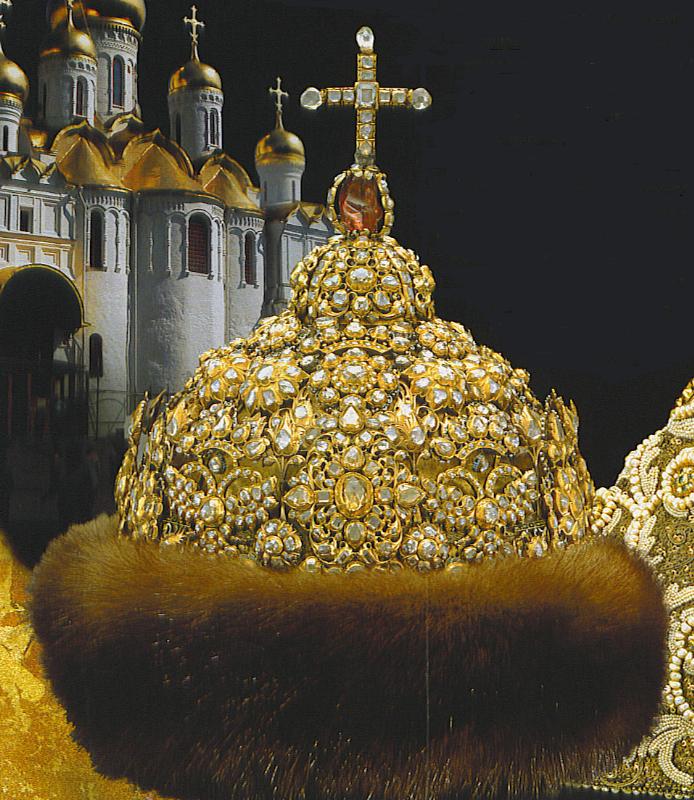
The Imperial Crown of Russia

The “miter style” crown is only used by two imperial courts, that of the Holy Roman empire and Imperial Russia. It signifies the close association between these imperial offices and the respective churches, nl. Russian Orthodoxy and Rome. This crown strongly resembles an orthodox miter. Wrought in silver and set with thousands of diamonds and a single large spinel, it truly shows forth the glorious natural wealth of Russia and the once magnificent Romanov dynasty. 

The Empress Consort Crown of Russia.

Set entirely of diamonds, there used to be two of these crowns in the collection but one was sold after the revolution by the Bolsheviks along with many other pieces. It is a "small" crown similarly in size to that of Queen Victoria's. 

Crown of Anna Ioannovna

An older version of the mitre style imperial crown. Made for Czarina Anna Ioannovna and containing diamonds and spinel. 

The Astrakh Crown

Also called the Cap of Kazan, this helmet-like crown was owned by the famous, Ivan the Terrible, first Czar of all the Russias

The Monomakh Crown

The origin of this piece attempts to be legendary but it is however uncertain. Dated around the 14th century and probably of Byzantium manufacture, if not just inspired by it. It does however prove the romantic fascination the early rulers of Russia had with the Byzantian ideal and marks the true bond between them and the Orthodox faith.

One of many lesser Bolshevic style crowns

Crown of Peter the Great

Another lesser Bolshevik Crown made of gold and precious stones and trimmed with fur

A replica of the Crown of Kazan made from gold and precious stones for the Imperial Family to be worn to a costume ball

The Altabas Crown of Ivan V

A Bolshevik Crown made for Nicholas II to wear to a Costume Ball

An empty frame

Crown of the Order of Malta

The head of the Order of Malta is an elected Princely Title in its own right. They are called; His Eminent Highness, the Prince and Grand Master of the Order of Malta. Paul I of Russia was elected to this position and had this crown made especially for this title. Even though the Order exists to this day and continues to be lead by an elected Prince, the crown however remains in Russia on display in the Kremlin.

Two nuptial crowns called "Stefana". These belonged to the Count Pushkin and was used by his family during the Orthodox wedding ceremonies.


Russia/Moscow/State Historic Museum (Permanent Display 1crown)

Crown of Swedish origin

(All images on this blog are considered defaulted to the public domain due to age and ready sourcing from the internet. If an image on this blog is disputed it will be altered or removed following written protest from an authentic source. please contact me at danielgswan@hotmail.com)

Thursday, 7 June 2012

Tehran 22 Antananarivo 23

Remember we are moving west on a North to South Meridian which now reaches one of the largest Nation Jewel Treasures in the world. The Tehran Bank houses the Crown Jewels of the former Persian Empire (22 on the map). Far South our imaginary meridian reaches only slightly west to the capital city of Madagascar, Antananarivo (23 on the map) which like Hawaii also has a Royal Crown. 


Iran/Teheran/Bank of Teheran (Permanent Display 4crowns)

The Pahlavi Crown

Used by Reza Shah Pahlavi for his coronation in 1926, this crown was also used at the coronation of Mohammed Reza Shah Pahlavi, the last Shah of Iran. Made of gold, silver and red velvet, it is set with pearls, 5 emeralds and 3380 diamonds, of which the largest weighs 60 carats.

The Crown of the Shahbanu of Iran

The wife of the Shah was known as the Shahbanu Farah Diba. this crown was made especially for her to wear at the coronation. It is made from diamonds, rubies, large carved emeralds and pearls. 

The Kiani Crown

The former crown of the Shah's of Iran typically is of far more ancient craftmanship.

The Crown of the Shazada of Iran

The Crown Prince and heir to the throne is known as the Shahzada and this is the traditional crown of the Shahzada. 
 
Madagascar/Antananarivo/Rova Palace Museum (Permanent Display 1 crown)

The Crown of Ranavalona III of Madagascar

The crown was damaged in a fire in recent years but is still in such a condition as to be exhibited. 

(All images on this blog are considered defaulted to the public domain due to age and ready sourcing from the internet. If an image on this blog is disputed it will be altered or removed following written protest from an authentic source. please contact me at danielgswan@hotmail.com)

Friday, 1 June 2012

Bhutan 18 Nepal 19 Sri Lanka 20 Kochi 21

This post begins in the small Kingdom of Bhutan (18 on the map) then moves to Bhutan's western neighbour Nepal (19 on the map). We move only slightly west from here but drop far south to the Island Nation of Sri Lanka (20 on the map) and we end off in the City of Kochi (21 0n the map) on the south western tip of India.


 Bhutan/Thimpu/Tashichho Dzong (Not Displayed 1 crown)

The King of Bhutan wears the traditional Raven's Crown. It is seemingly embroidered with gold thread and includes precious stone beads. 

Nepal/Katmandu/Royal Palace (Permanent Display 1crown)

The now ousted King of the former Kingdom of Nepal is seen here wearing the Crown of Nepal less than a decade ago. It is made of gold and includes large diamonds, rubies and emeralds and pearls. Its distinctive feature is the large feather which is reserved for the King's Crown only as many nobles wear similar crowns. 

Sri Lanka/Colombo/ Colombo Museum (Permanent Display of  1 crown)

The Crown of  Sri Vikrama Rajasinha, King of Kandy 1798

The Kingdom of Kandy was an independent state until it was ceded to the British Empire in 1815. Since then the Crown of the former King has been displayed as a historical object. 

India/Kochi/Thripunithura Hill Museum (Permanent Display 1crown)

The Crown of Kochi

Once an semi-dependent kingdom, Kochi's rulers established this crown as the symbol of the city-state's kings. Made of gold and precious stones, this crown has a weird tradition attached to it. The crown was never worn on the head but was rather held on the lap of the king while seated in state upon the throne.  

(All images on this blog are considered defaulted to the public domain due to age and ready sourcing from the internet. If an image on this blog is disputed it will be altered or removed following written protest from an authentic source. please contact me at danielgswan@hotmail.com)